Living with Alzheimer’s
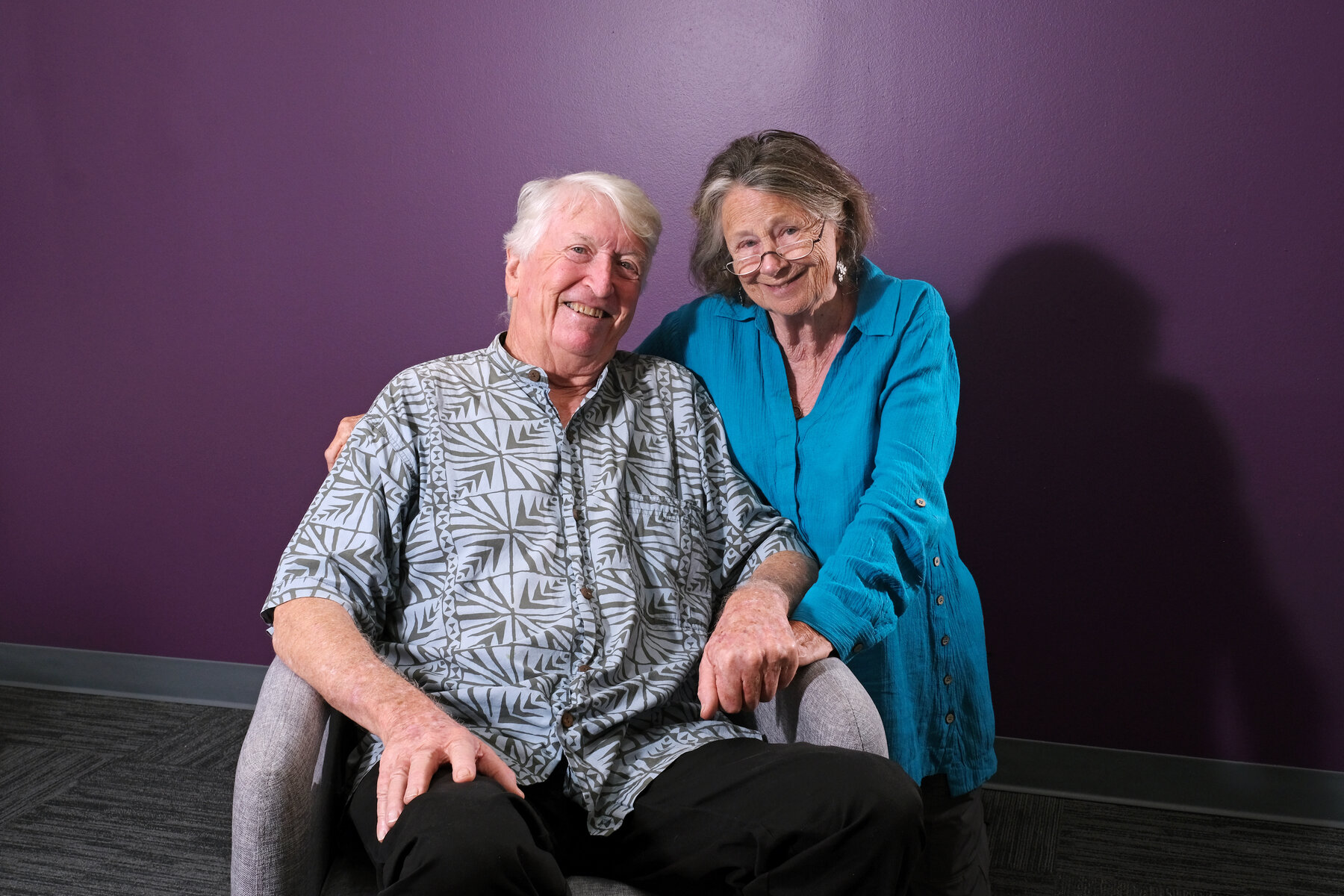
Peter Black and Barbara Black share personal stories and experiences related to their life with Alzheimer's disease. They hope to provide a glimmer of understanding and support to those affected by Alzheimer's, including patients, families, and caregivers.
Continue to help to end Alzheimer’s by registering for the 2026 Walk to End Alzheimer’s on September 12, 2026 in Hilo and join our Team Honohina.
Peter’s page is at: https://act.alz.org/goto/PeterBlack
Barbara’s page is at: https://act.alz.org/goto/BarbaraBlack
Team Honohina is at https://act.alz.org/goto/TeamHonohina
Team Honohina walking to end Alzheimer’s in Hilo and Koror, Palau, and on Hatohobei Island (aka Tobi)
A bit about us: Peter, an Alzheimer’s patient, is a George Mason University Emeritus Professor of Anthropology, and an amateur potter.
Barbara, Peter’s caregiver, is a retired Federal civil servant, an author, orchid and cat fancier, and an amateur potter.
For more about who we are, go to:
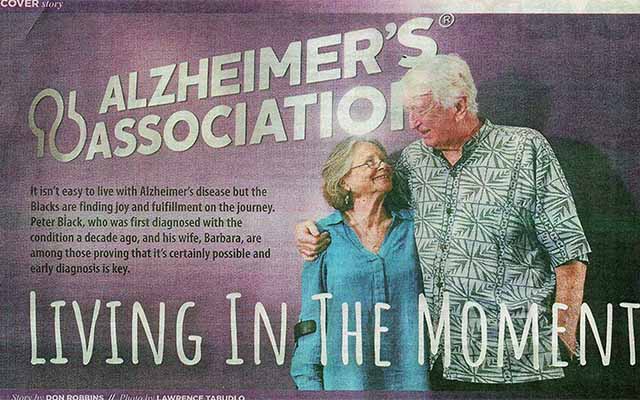
Midweek O’ahu: November 5, 2025:
https://www.midweek.com/living-in-the-moment/
Story by Don Robbins Photos by Lawrence Tabudlo
________________________________________________
And an introduction by AlzHawaii:
Meet Peter and Barbara Black... a love story of courage, hope, and determination.
When Peter, a retired anthropology professor, began noticing memory changes, his wife Barbara encouraged him to get evaluated. That decision led to an early Alzheimer’s diagnosis... and ultimately, access to new treatments helping him preserve precious time and memories.
Today, the Blacks travel from their home in Ninole on Hawaii Island to Oahu every two weeks for Peter’s treatments. It’s not easy, but they say it’s worth it. Together, they are raising awareness about early detection, access to care, and the importance of talking openly about the disease.
“If you get the bad news,” Peter says, “don’t hide from it. Live your life, but live it in the light of reality.”
Read their inspiring story featured on MidWeek and learn how early detection and treatment can make all the difference:
www.midweek.com/living-in-the-moment/
Peter’s Alzheimer’s Reports
Report 1: Alzheimer’s & Me: Some thoughts about living with dementia
Report 3: My Alzheimer’s Story Continues
Report 4: Two Days With Alzheimer’s
Report 5: Sleeping With Alzheimer's
Report 6: Having Fun With Alzheimer’s
Report 7: Living with Alzheimer’s Report # 7
Column: Provide resources for early Alzheimer’s diagnoses, care By Peter Black
March 5, 2026 Honolulu Star-AdvertiserEarly diagnosis is critical for those with Alzheimer’s, Peter Black’s Letter to Editor, Hawaii Tribune Herald, March 22, 2026
Report 1: Alzheimer’s & Me: Some thoughts about living with dementia
Was I aware of ALZ while I was growing up? If so, it was only as the disease was generally understood in those postwar years. For example, some elderly people were said to have entered their second childhood. “Senile” was a word I learned, without really understanding what it meant. I do know most people seemed to feel it was something pitiful and maybe even shameful, but it was something I never witnessed. Both my parents died long before their time, but several members of my large extended family may well have had some form of dementia in their older years. This was long after I had left home, however, only to return for short visits, and my interactions with those people were minimal. Over the years, in which I have lived in many diverse communities around the world, I don’t think I got to know more than a few (if any) people as symptomatic as I am now. This is not to say that I didn’t know that, if I managed to live long enough, there was some risk that I would become demented. In fact, being tested for sleep apnea when I was in my fifties gave me a foretaste of what that might be like. This involved spending a night in a hospital to have my sleep monitored. Since there was no separate ward for such a procedure, I was given a bed in what must have been a geriatric ward. As you might imagine, it was a far from peaceful night, but I don’t think it had much of an impact on me at the time. Still, the disease slowly became one of the things I came to dread as I thought about growing old, mainly because several things happened over the years which might well have been its early manifestations.
Forgetting in 2007 that someone I liked, but who I had not seen in a while, had in fact died; losing a car in a very small parking lot; taking early retirement because I was finding it more and more difficult to do justice to my job as a professor; and, after retiring, failing to learn more than a few words of the language of a country where I worked off and on for three years—these are some of the signals that led my wife Bobby and me to take seriously the possibility that something might not be quite right with my mind. Finally, in 2015, I decided to see a neurologist.
I was diagnosed with mild cognitive impairment. This was hard to hear but I could not disagree: a simple word test demonstrated very clearly that, while I could take in and retain a short list of words read to me, I was unable to retrieve the full list, even after multiple attempts. Then in 2018 as I was being screened for a drug trial, I had a PET scan of my brain which produced a definitive diagnosis: late onset Alzheimer’s disease without behavioral disturbance.
I have no regrets about that decision to see a neurologist. I have complete confidence in the doctor I did see and am happy to remain his patient. Still, this diagnosis is not one that is easy to be comfortable with and not a day goes by that I don’t think about it. Alzheimer’s casts its shadow over just about everything and although I am certain we are not obsessed with it, Bobby and I talk about it almost every day.
It’s going on ten years now that I have been living with the certain knowledge that my cognitive ability is waning. Being reasonably bright always has been an important part of who I am, so the steady loss of IQ points takes some real getting used to. Furthermore, it's not just shopping lists or vocabulary items that are difficult for me to remember. A failing memory is also the reason that I am not reading books these days, even though for my entire life I have found great pleasure, and learned enormously, from them. It is not that I can’t comprehend what I am reading as I read, but the next time I pick up that book I am forced to continually look back to find things I have forgotten. Fortunately, listening to a book, especially one that has a strong narrative flow and is both well written and well read, still gives me great pleasure. For some reason remembering what I listened to the previous day is simply not an issue. Long early morning walks along the country road on which we live, with our dog on his leash, and a book playing in my ears, is for me one of life’s great pleasures. And yes, I have much to be grateful for.
Bobby, who has significant health issues of her own, has been incredibly supportive. With her support I have been able to continue to live a very full and happy life. My neurologist is amazing, and I feel very fortunate to be his patient: he is always willing to explain his thinking, is clear and thorough in his answers to our questions, very thoughtful, patient, and understanding. Our family and many friends have helped me stay afloat with their love and unfailing kindness while also supporting Bobby in many ways as she takes up the burdens my illness entails. And, of course, I recognize that I am very lucky in the slowness of my deterioration.
A failing memory, which is increasingly evident, is not my only symptom. Declining executive function is resulting in an increasing tendency to make bad, or at least far from optimal, decisions. I am also able to do less and less without bringing on a bout of fatigue. On the other hand, over the last few years, and without going on a diet, I have shed 30 unwanted pounds. Who knows why? Could it be that this unplanned return to a healthier weight is because my brain has been working overtime trying to cope, thus burning through body fat? In any case, an unintended consequence is that I can now wear some of my favorite (if perhaps a little retro) clothes. And an even more positive outcome of losing that weight is that I no longer have apnea symptoms.
Turning now to some of the accommodations we have made in our lives in response to my diagnosis, I guess the most dramatic is that Bobby now does all the driving. Like all such decisions this is something that we talked out thoroughly between ourselves and with my neurologist. Several years ago, and because of that diagnosis, I had to pass a road test to renew my driver’s license. I was absolutely stunned when the examiner announced that I had failed. Over 60 years of driving, not all of it perfect perhaps, but still. Then followed a few weeks driving with a learner’s permit with Bobby as the adult driver in the passenger seat and me as the nervous teenager. Once I successfully renewed my license, though, nothing happened while I was behind the wheel that led me to think I should stop driving. (In fact, some part of me still feels that I can continue to do so safely.) Nevertheless, I was skeptical enough of my ability to make rational decisions that I opted to accept the fact that the odds were against me. I quit in two stages: first restricting my driving to destinations within our immediate neighborhood, namely our local post office and dump and then (just recently), giving it up altogether. The impact of this is considerable because we live a good distance from town and up until then I had done considerably more than half the driving. So now we try to complete as many errands as possible when we go in while avoiding as many single errand trips as we can. I just ride along in the passenger seat and try to keep my driving tips to myself. I still do most of the cooking and a good share of the housekeeping chores and outdoor work. I am more and more reluctant to take on highly complex or physically demanding projects, though. This means that we eat simpler meals and spend more money paying someone else to do things I might well have done myself in the past. I still do most of the grocery shopping but do so now from lists we have made together in advance. I can no longer carry even a very short list in my head. The decline in my executive function has produced several spectacularly bad decisions so I now run any potential decision past Bobby and always defer to her judgment. In other words, my self-confidence is not what it was, and rightly so. But I can say that I have accepted the reality of my condition and have more or less made my peace with it.
As we did with driving, both of us continue to learn how we can accommodate the continuing decline in my cognitive ability by learning new ways to manage daily life. And we talk openly and often about Alzheimer’s and its ins and outs—from Bobby (aka my external hard drive) reminding me to take my medications, to long discussions about how the brain works and especially the tactics and strategies best suited to our situation. Bobby lives with a long-term illness, too, and until recently our lives were organized around that. Until my diagnosis, I always assumed that I would take care of her. Now both of us need to accommodate and be accommodated to, but we live with the knowledge that whatever happens, we will continue to be there for each other.
Here I need to say that one of the reasons I am writing all this now is that I find myself increasingly forced to pause so that I can search my mind for a word I want. And sometimes that search is unsuccessful. I am coming to fear that sooner or later I could totally lose the ability to use words meaningfully.
“Talking only makes it worse.” This sentiment was written on a small slip of paper, which was handed to me long ago by an old man who up until then had never responded to the greetings I offered every morning as I walked past. This struck me as an inscrutable sentiment. I didn’t take it personally, after all that note did not read “talking with you” but I just couldn’t understand what he meant by it. “Worse,” how? Then to my surprise the other day while sorting through some old files I came across that scrap of paper and now I think I might have a clue to what he was getting at. It seems to me that constantly having to pause to search my brain for the specific word I want to say or write might eventually become such a struggle that I just don’t want to do it anymore. Already, and to my chagrin, writing a set of coherent sentences expressing what I think or feel is becoming more and more difficult. In fact, were it not for Bobby’s fine editorial eye, this piece would never have seen the light of day. For now, though, I am still willing to enter into conversation with anyone who is willing to talk. To tell the truth, I fear that I am closing in on actual garrulousness, increasingly unwilling to cut a long story short, but always willing to make that long story even longer. The language retrieval problem, first made clear to me by my neurologist, is now showing up not just in my inability to repeat a small set of words read to me a short time ago, but also in my inability to immediately find words I have known forever when talking, writing, or even just thinking. For example, early the other morning I was thinking about the pros and cons of adding yoga to my life only to burst out laughing when I realized that instead of “yoga” I was using the word “judo.” And spelling? Well, I won’t go into it, but Miss Lyla G. Woods, my grammar school teacher, would spin in her grave if she knew just how bad it has gotten. (Spell check flagged five misspellings in the previous paragraph!)
I do not want to paint too dark a picture here. Even though there are occasional late-night bouts of sadness, regrets, doubt, and questioning of my self-worth, there is much in my life that I find rewarding and meaningful, and for that I am very grateful. I deeply enjoy long telephone calls with good friends and family, not all of which are restricted to medical issues or the details of daily life. In my opinion at least, I am still able to make a reasonably funny joke now and then and continue to enjoy the ones I hear. And every once in a while, a few phrases of one of the several languages I knew but no longer speak come back to me when I am talking with a native speaker, and I can drop them into the conversation. Being able to continue throwing on the potter’s wheel is a particular pleasure. Working with ceramics, a long-term hobby, is something I value because it is, for me at least, very much a right brain pursuit: no words, no paper, just clay, music and muscle memory, and I am finding it increasingly important as a form of self-expression. Common sense though, has led me to give up trying to fix my ancient electric kiln.
I ‘ve been told more than once that I have a tendency to be overly self-critical, but lately I am getting to the point where I occasionally am willing to give myself a pass. Alzheimer’s brings with it an increasing probability that you will do (or say) something wrong such as sending your cell phone through the wash. Well, when I recently did just that I realized that my diagnosis is a kind of “get out of jail free” card. If it had been someone else’s phone, I would never have mentioned that excuse.
And of course, I am doing what I can to push back at this disease. This includes daily doses of memantine and donepezil which I have taken for some time now. Late last year I began receiving bi-weekly infusions of Leqembi (lecanemab) (a drug that has been shown to slow the progression of Alzheimer’s damage). Unfortunately, this spring an episode of atrial fibrillation raised the risk of stroke to an unacceptable level, and I was unable to continue with the infusions. Now, however, following a bit of surgery to place a device (called Watchman!) in my heart, I am looking forward to getting back on Leqembi in a few months. I try to stick to a Mediterranean diet, to walk 3 or 4 miles a day, and spend some time each day on challenging (for me at any rate) puzzles, in hopes that I can slow down my mental decline.
We plan to remain in our home as long as we can and hope never to have to leave it. This is a goal made practical by our great good fortune in being able to offer a rent-free home on our property to a young couple who are very good friends of ours. In fact, the four of us are one family in almost every meaningful sense of that word. They are a great help to us now and we’re sure they will continue to be so in the future.
The arrival of Leqembi and similar drugs raises the hope that Alzheimer’s is perhaps beginning to yield to the huge effort going into developing treatments and therapies. The Alzheimer’s Association is a key partner in this crusade. Bobby and I were inspired by last September’s Walk to End Alzheimer’s which took place in Hilo’s beautiful Liliuokalani Gardens. This was our first experience as part of the Alzheimer’s community and we found it extraordinarily supportive. There were just so many good people, from so many different backgrounds, each with their story as a patient, or family member or friend, or caretaker, and all committed to doing what they can to move the needle on this very difficult disease. We are looking forward to this year’s walk and hope you will join us, in person if possible, in spirit if not.
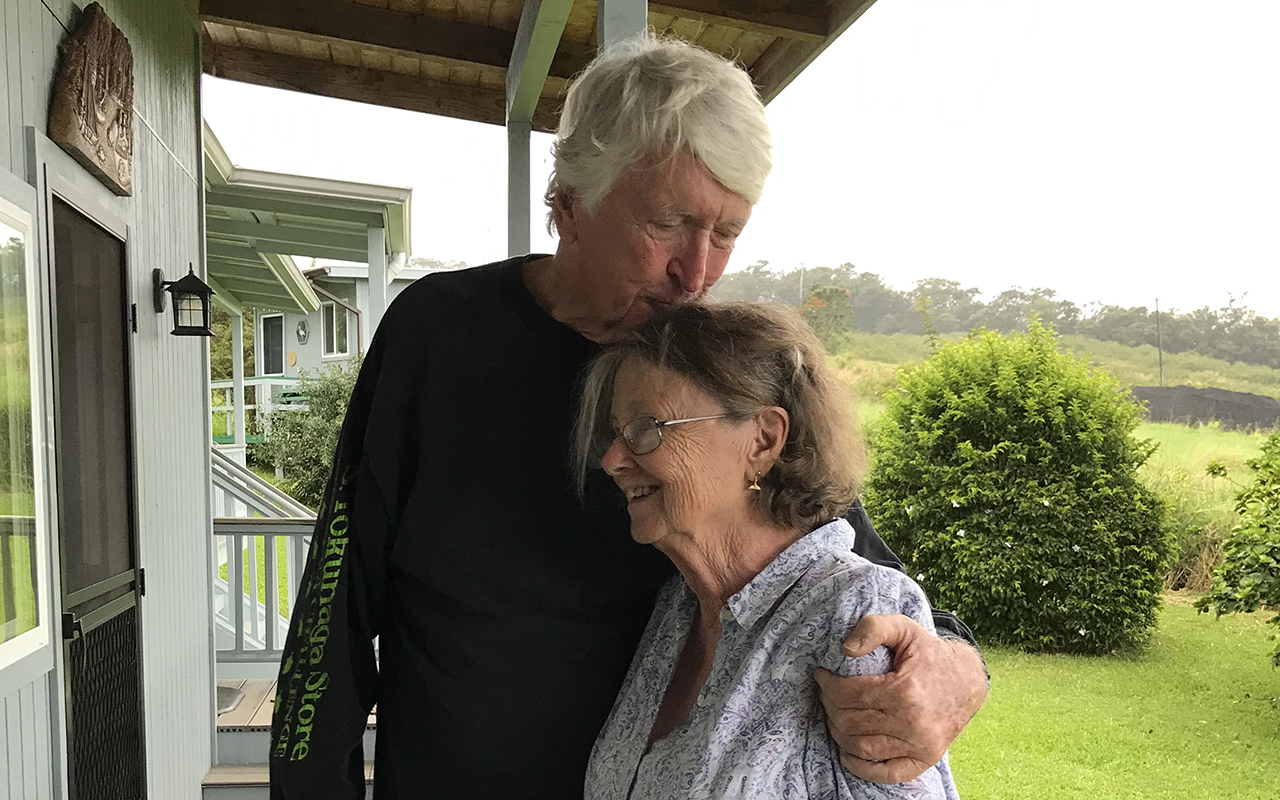
Peter Black, Honohina, Hawaii, 2024 Back to Home
Report 2: How I Came to Support the Alzheimer's Association
Here is an extended version of a talk which I gave on the evening of July 24 at an Alzheimer's Association Hawaii Island community leadership meeting held at the Hilo Yacht Club. Bobby and I had been invited by Erin Clemons, Manager, Walk to End Alzheimer's. After being introduced, I began with these words.
Good evening. I am a George Mason University Emeritus Professor of Anthropology, peacefully retired to a beautiful home in Ninole, which my wife Bobby and I started building in 1996. We happily grow all kinds of things that we never could have grown back in Virginia and between our gardens and ceramics (we are both amateur potters) we have more than enough to keep us busy and contented in a home we hope never to have to leave.
Next month I will be 82 years old. And, since 2016 I have been living with the knowledge that I have Alzheimer's disease.
In her invitation, Erin asked me to share, in a brief story, why I became a supporter of the Alzheimer's Association. I accepted her invitation but only after warning her that one of my symptoms is that, for me, a brief story might be one that went on and on and on.
Erin's question led me to ask myself why I became a supporter of the Alzheimer's Association. And then I realized that there were not one but two questions for me to answer: what took us so long? And what happened on our first Walk last year to convince us to become supporters?
During the years after my diagnosis, Bobby and I had been focused on figuring out how we could best cope with its massive impact on our lives. It was our immediate problem, and we needed to deal with it, and we have, but it took some time. Many of our assumptions about the future had to be rethought and the pattern of our daily life adjusted to accommodate this new reality. A big part of this process for me was to accept the fact that both my energy level and my physical strength were steadily decreasing. This was not easy, and it took a good deal of time, but, supported by family and friends as well as my doctor, we managed to find a way forward. During that time, we were not really attending to any larger picture. Of course we were aware of the Alzheimer's Association, but if asked, I am sure we would have said that we could find neither the time nor the energy to take part in any of its activities. But, by last year, we finally had reached a point where we were comfortable enough with Alzheimer's in our life to register for the Walk. And the fact that it was to be held in one of our favorite places on this island, Queen Liliuokalani Gardens, Hilo's magical seaside park, made the decision to register for the Walk a real no-brainer.
Looking back almost a year later, I don't think we had any idea what to expect. When we got to the park, the first thing we noticed was the large and very lively crowd. It was made up of people of all ages, shapes, and colors, all obviously happy to be there. And, we discovered, happy that we were there, too. Their aloha spirit was so infectious that we were immediately swept up in it. In short, we really felt welcome. Many of the people we met while we waited to start the walk already had done it many times, over many years and, for some of them, in many different places. As we talked with them, it seemed they all had a personal reason for being there. Some were or had been caretakers of folks with the disease, others had lost people close to them to Alzheimer’s or had people they cared about who were now living with the diagnosis. I sensed that for many of them going on the walk was a way of pushing back at that disease—my disease. Soon enough the positive atmosphere generated by all this led us to sense that this was a community we wanted to join and in which we could both feel at home. We also had discovered by this time, in our different ways, that we needed all the help we could get.
Shortly before the actual walking part of the Walk, I was called to the front and given a beautiful lei as well as a big blue plastic flower on a stick. I was being honored as a person who had been diagnosed with Alzheimer's and the blue flower was a symbol of that fact. That announcement seemed to bring forth a wave of support and as we headed out on the walk quite a few people came over to speak with Bobby and me. Since Bobby uses a rollator for a walk of any length, some of them assumed she also had Alzheimer's. We explained that she did not have that disease but did have MS, which made walking difficult but did not stop her from being my caregiver, just as Alzheimer's has only modified but not ended my role as her caregiver. In these moments I felt like we were among friends. Friends who were doing something about the disease.
For me, supporting the Alzheimer's Association is the best way I can use my time and energy to (1) support other people affected by the disease and (2) help bring closer the elimination of Alzheimer's disease. So, in attempting to answer Erin's question, I have come to see that the walk has given me agency. In other words, it was an inspirational experience. And actively supporting this organization is one of the things it has inspired me to do.
Peter Black, Honohina, Hawaii, August 2024 Return to Home
Report 6: Fun With Alzheimer’s
Yesterday was one of the most enjoyable days I can remember. In fact, I barely slept last night out of sheer joy. This even though there has been no slowing in the rate of my decline since the last time I wrote one of these reports, and even though I was completely worn out from a recent two-week trip to the East coast. It was, simply put, a very, very, wonderful day.
From early afternoon until deep into the night our home was the setting for the largest party we have ever hosted—or even attended, for that matter. Under four big canopies spaced across the lawn, and on our big lanai there were tables laden with food, coolers full of iced drinks, and bouquets of orchids and roses. The smell of barbequing arising from several different grills, all well attended by interested parties, complemented the excited laughter of people dancing on the grass to the Palauan songs, both recent hits and Golden Oldies, which Julian sang as he accompanied himself on his keyboard.
All this was in celebration of Bobby’s 80th birthday, a celebration that brought together about 75 people (estimates have run from 50 to 100), not all of whom knew each other, but all of whom seemed to be having a good time.
We had been of two minds about that trip back East. Neither of us is as strong as we were just a few years ago. My stamina and physical strength would be taxed by this and Bobby, who now requires oxygen, travels with heavy batteries and a portable compressor. After all, our biweekly trips from Hilo to Honolulu and back for my Leqembi infusion can leave us exhausted. But. . .We decided to roll the dice and take advantage of this chance to see, in all likelihood for the last time, beloved East coast friends and family.
The genesis of the trip was an invitation to a surprise birthday party for one of our dearest friends. In fact, she and her husband are more like our siblings than just friends. So, we knew we would go if at all possible. Then the issue was settled for us when we learned that our son and his family would be coming down from Canada for this event.
Our flight East was scheduled on an infusion day and our return to Hawaii the day before the next one, thus giving us a good two weeks to spend time with friends and family, from Maine to Virginia, finishing up at that surprise birthday party. All packed up and ready to go, we boarded our flight in Hilo and set off for Honolulu and the infusion center. But when we arrived, we found ourselves confronting a possible disruption to our carefully planned schedule.
Early that morning I had mentioned to Bobby that my right eye was acting a little odd. Things at a distance seemed blurry when I covered my left eye. Over the next hour or two I think I must have gotten accustomed to this, because when she mentioned this to the nurses who were prepping me for the infusion, it came as something of a surprise. It was still there though, and the nurses decided my neurologist needed to hear about this before going ahead with the Leqembi. He was in his car at the time, but they were able to reach him on his phone. After a roadside consultation, Bobby and I were rushed to the emergency room in wheelchairs pushed by the infusion nurses. Any anomaly that might have indicated a stroke, or anything associated with it, needed to be understood before I could be infused. The best and fastest way to do this was to get to the ER and its MRI. It turned out that the emergency was not in my eye, but in our schedule. The departure of our overnight flight to Boston was drawing ever closer with each minute that passed. Everyone involved took that reality very seriously, and I was in and out of the ER in record time. There was no sign of a stroke, and Uber got us to the airport just as the plane was loading.
Oh yes, after we returned, I saw our ophthalmologist and she soon found that the problem in my right eye was caused by a film which had formed over the lens that had been inserted years ago when I had a cataract removed. This was the first I had heard of such a problem. She said that it was easily fixed by having the lens laser scraped. As I write this I have yet to undergo that scraping. I have an appointment next month and I will keep it, but I can’t help being a little nervous, even though I have been assured that it is painless and very quickly done. If there was one thing that I learned as a kid, it was “do not put anything in your eye.”
Our trip to the East coast was exhausting but also deeply rewarding.
The surprise birthday party was a huge success. For me, the big surprise was that it actually was a surprise. This was a very complex event, planned and executed by her husband and two daughters. I have no idea how many people kept the secret for the month or two leading up to it. But I do know that she had no idea what was waiting for her when she opened the door to the restaurant. I can still see the stunned look on her face when she saw us and many other people, rising to their feet in the darkened room to greet her.
So here I am, writing about another birthday party. At which I had a very good time, perhaps not in spite of Alzheimer’s but, at least in part, because of it. It was no surprise that I could not remember the names of many of the people who came to our table to say hello. Most, but not all, I recognized as someone I knew and liked, and even those I didn’t recognize seemed glad to see me, but I could name only one or two. I am used to this by now, and I am pretty sure most, if not all, of them knew that I have a dementia, because they provided their names as we hugged or shook hands.
As the evening progressed our two small grandchildren, along with their new friends, our host’s two small grandchildren, appropriated the lower reaches of the room, especially the area underneath the tables and chairs. Their new playground gave them plenty of space in which to create some pretty rowdy games. This seemed to be ok with all the adults, probably because many of them were also grandparents. But at one point things might have gone south if I had been more my old self.
While trying to have a conversation with the other three people at our table I was overcome by a flurry of stickers the kids began plastering to my face and neck and hands. They started rather tentatively but when I didn’t react they fell to work with gusto. I ended up with layers of stickers stuck onto each other, covering my whole face, including eyes, nose, and mouth. Once they had expended all their ammunition they fled, giggling. Of course, the other people at the table were highly amused and so was I. But it was a bit puzzling that I had been so passive. I had done nothing to stop them, let alone reprimand them for doing something which, had I done at their age, would certainly would have been brought to a halt by some adult. And if it had happened to me at an earlier time in my adult life, I don’t think I would have put up with it without at least trying to stop them after the first two or three stickers were applied. As I thought about this later it seemed to me that somehow ALZ was changing me in ways that I had not expected. I won’t say that dementia made it fun to be outfitted with a mask of stickers, but I do think it made it very easy to bear.
Bobby here: Alzheimer’s is very strange; or perhaps its strangeness comes out of the person who is carrying it around in their brain. I agree with Peter that years ago, he would not have passively been stickered. However, I can testify that he has become a perfectionist in many things. This is particularly noticeable in his writing, be it something like this report or a short email. All must be correct and I, who used to be a perfectionist in many things, am quite happy to drop that and say, OK, that’s fine. Done. Is this because of his underlying personality and character from before? Or is it what happens randomly when the amyloid and tau come and go in his brain?
That party happened toward the end of our trip East. The next day we said goodbye to our son and his family, visited our twin nieces, and packed. We flew out of Dulles the following day, after having one last visit with an old friend. The trip home was made difficult by our exhaustion but happened with no incident.
Once I got back on my feet, Tintin and I set to work organizing things for the party we were organizing for Bobby. We made a good team. I was full of ideas which she could either accept or reject. She had other ideas, usually much more feasible, that I was happy to go along with. We wanted it to be big, with as many of our friends and family as possible. Having lived on the Hamakua coast of the Big Island for 15 years, we have come to be very fond of quite a few of the people here. We also have friends on Oahu. Tintin, who in 2013 came to stay with us to go to college, has a big local network and Julian, who came a few years ago, has relatives living just down the road. Our motive for going all out was our wish to celebrate the person who keeps our small ship sailing so happily along. Of course, inviting so many people meant it was going to be a lot of work. But, in our enthusiasm, that didn’t matter. It also meant that this was going to be an outdoor event. Somehow, the fact that we live on the (very) rainy side of this island did not enter into our decision making.
We had set a date and sent out a few invitations (beautifully designed by Tintin) before Bobby and I left for the East. Now, in the two weeks remaining before the big day, we pulled out all the stops: putting out the word to all our friends and relatives in the State of Hawaii. Naturally, every effort was made to guard against my failing memory. So, for example, I created an elaborate spreadsheet to track who was coming. This worked moderately well, but it wasn’t perfect. In the days that followed the party, we realized there were a few people who I thought were invited but apparently were not since their names were not on that spreadsheet. At this point in my life I am not surprised by this and remain thankful it was my only screwup.
This was to be by far the biggest party we have ever had here, but it was far from the only one. For years we had co-hosted a big New Year’s Day party with our friend from across the road, the late Brent Gallagher, but no longer. We also have had parties for Tintin and Julian. His was the most recent: almost an all-night affair. Bobby and I abandoned it early, but not until Tintin and Julian had gotten me to explain to their fellow Palauans how I came to be involved with their country.
Then the party for Bobby’s birthday happened. It was great. The food and music were wonderful, and Bobby was welcomed into her 8th decade with a well-deserved celebration. Tintin had fixed up a remote microphone, which she used to broadcast a blessing before we ate. Unfortunately, our dog George, inspired by my stentorian barking voice, decided that folks would rather hear him bark at a stentorian level and since he was standing right next to Tintin, she was a bit unnerved by all of this and the blessing went unheard. Before then, though, I had a turn at the mike and barked out some words in as close to the stentorian voice of one of those great WWII correspondents as I could manage. Here, lightly edited, is what I said, or rather barked out:
It is May 1945: The last great battle of World War II is raging on Okinawa. A young American sailor stationed in the Philippines is wondering if his baby has been born yet. And then on the 24th of May, in Chicago’s St. Luke’s Hospital on the shores of Lake Michigan, Barbara Derry Webster arrived! AND THIS WORLD BECAME A MUCH BETTER PLACE!
About 700 miles east, in Rome NY in the Mohawk Valley, two-year-old Peter Weston Black suddenly became aware that it was his destiny to find a certain someone. But who? And how?
Forward 32 years to July 1977: George Mason University, Fairfax, Virginia. PWB, now with a PhD in Anthropology, starts a new job at this new University. Summer school is in session, classes are small, most of his students seem to be less than interested. Still, he is lucky to have the work to pay the bills through the summer.
After a day or two it becomes clear that one student is vastly different: smart, funny, interested; a grown up, a fellow smoker and a good conversationalist, and, not a lot younger than her professor. Like no student he had ever taught before. Yes, this is when the two finally meet.
However, lightning does not immediately strike. Instead, a friendship arises.
She is at Mason to finish her undergraduate degree, having dropped out of college 12 years ago on a matter of principle. Leaving New England for New York City she found work as a secretary in a Wall Street law firm, only to rise rapidly to become the first paralegal on the street while taking several courses at NYU. Later she moved to the DC area where she worked for one of Washington’s great labor economists, while at the same time pursuing her interest in the hospice movement. This led to a trip to London where the movement has its roots.
Time passes: she finishes her degree. Even though he had given her a B on one of her papers, they are still friends.
Then multiple sclerosis attacks her body. To obtain medical insurance she takes a job in a small government agency that helps to regulate the financial system and begins a 23-year career as a civil servant. On her own initiative she reaches out to the agency’s staff in what would later be called a Diversity, Equity, and Inclusion program. She also helped to shut down more than a few predatory criminal enterprises.
She writes a very well received book about M.S., which he reads in draft.
They continue to see each other once in a while, as friends do. He comes to see her strength in the face of hardship and pain, never losing her balance, never succumbing to self-pity, always ready to pick herself up and to move forward. No cruelty, no greed, but a gentleness and deep respect for herself and for others—with the exceptions of certain blowhards, charlatans, criminals, and politicians.
At long last, on an evening in 1983, they look into each other’s eyes, and suddenly he knows, and she knows this truth: They have found the person they are meant to be with.
They married nine years later.
WHY WAIT SO LONG? THAT’S ANOTHER STORY.
But I will say that we celebrated our 20th anniversary in Palau where one evening we renewed our vows on Eang’s beach. A “re-wedding,” people called it and so it was. Our daughter Soty, Tintin’s older sister, made a wonderful Peeps cake and we were surrounded by many friends from near and far. A beautiful evening under the stars, with the sound of the waves, and so much music and so many hugs and smiles. A very precious memory.
So now I’ve had my say. Except for this one last and perhaps most important reason we still are together. She always laughs at my jokes. Including this one.
I am happy to say that hosting a huge party is far from the only way I have a great time these days. Even though Alz is diminishing me by the day, I can honestly say that I am enjoying myself in one way or another on almost every one of those same days. Somehow, I seem to have just put aside the darker side of my current reality. And recently I have discovered a way to use Alzheimer’s to have a very good time simply by dialing the phone.
There were seven other people in my immediate family. Sadly, over the years that number has gotten smaller and smaller until now there are only the three of us: myself and two of my younger siblings. Sadly, one has full blown Alz and the other is almost certainly coping with some form of cognitive impairment. Even more sadly, both live thousands of miles from here, so we haven’t seen each other since last year. Luckily, long distance calling is now pain-free, so at least we can talk without going bankrupt. So, I call l them quite often.
Up until a couple of days ago, our conversations were rather stilted. They were happy enough to hear about what was going on here and could be counted on to offer a few comments as I bemoaned our national politics (our dad had a brief career in local politics and we grew up in a home where politics, local and national, were much discussed). But a sustained conversation was quite rare. One would have a hard time putting thoughts into words and seemed to have very few retrievable memories for quite a long stretch of their life. The other was talkative enough but for some reason we rarely hit on a topic that could get us really excited. Now we have found a topic which totally interests the three of us and about which each has a lot to say. I am definitely not talking about Alzheimer’s disease here. Instead, it is our common heritage.
We grew up together and we all still have vivid memories from our childhood. Since there are several years between each us, our childhood memories do not totally overlap and the ones that do are memories made at significantly different ages. I have several that predate their appearance on the scene, and they have some of events which occurred when I was no longer living at home.
Yesterday I called them both. As soon as the conversation lagged, I said that I had just realized that there are three stories about our father that they probably hadn’t heard because they were so young when they happened. This news was greeted with great interest. I told these three anecdotes at some length and with more than a few flourishes. With lots of excited laughter each call went on for quite a while, with one person after another bringing up a family story, only some of which I already knew. Both of them said that we should do this again soon. I am looking forward to dialing them up in a day or two because those calls were just so much fun!
It’s been almost more than two months since I started to write this, and I need to end it soon. Bobby has been working on our new website for almost as long and she is almost done. She even has a link ready for this report.
Before I close I am glad to tell you that earlier this week my right eye was lasered and it is now as good as new. It was far from a high stress experience, and I am very happy I decided to do it. On a less positive note though, I should also tell you that since my last report I have definitely become more prone to foul ups and errors, that my walk is less confident, and that my memory, agility, and general competence are all failing in one way or another. You get the picture, I guess.
Of course, since my 83 birthday is just a few days away, I really do not have grounds for complaint. And, despite occasional very dark and fearful late night moments, I really do not have any at all. I know and feel that I am lucky to be alive and as healthy as I am, living a life I could only have dreamed of when I was younger. One wonderful moment occurred recently when Julian, Tintin, Bobby, and I played trilingual Scrabble. Tobian, Palauan, English—words from any of those languages were accepted and knowing their meaning was no prerequisite. What followed was an hour or so of laughter and great jokes.
Speaking of dreams—were we? My brain continues to generate amazing dreams. The latest is not exactly X-rated, but it’s close. It seems that either big pharma or some other bad actor began marketing an innocuous looking small white pill that, when taken with a glass of water, immediately induced a state of intense sexual arousal. The consequences of this scientific breakthrough were far from good. Demand soared, regulations failed (the regulators couldn’t resist taking them) and chaos overwhelmed everything.
Yesterday was Tintin’s birthday. The four of us went to one of Hilo’s nicest restaurants, one that looks out over Hilo Bay, for her birthday dinner. In its own, relaxed and quiet way, this was also a very special celebration. We first met this amazing young woman in Palau when she was a very young girl (the youngest person in her family). She eventually came to live with us to go to college and then, after graduating and moving to Texas, returned to stay with us because she knew that we would be needing her help to stay in our home.
Bobby here: Peter and I do talk often about the future and how we will manage. He worries a lot. I tend to be relatively sanguine about this because in my mind one cannot know such a thing in all its complexities until it happens. This does not mean that I don’t spend time worrying about the future. I do. And as Peter fails, and I try to pick up more of what he needs, I often blanch at any thought of the future. I do think that for us all the talking we do about Alzheimer’s prepares us in some small part for that future. Just lately, his mood has darkened and, of course, there is no way to mitigate that. Such an uncertain future we face; but everyone, whether or not they recognize it, faces an uncertain future. We are lucky in our knowledge of a good part of what the future portends for us.
Thanks for reading this. Since you have gotten this far perhaps you would like to join Team Honohina. You can register for the Walk to End Alzheimer’s on September 20 in Hilo and join our Team Honohina all without donating to the Alzheimer’s Association.
However, it is a fundraising event so feel free to contribute in our names.
Peter’s page is at: https://act.alz.org/goto/PeterBlack
Barbara’s page is at: https://act.alz.org/goto/BarbaraBlack
Team Honohina is at https://act.alz.org/goto/TeamHonohina
Peter Black, Honohina, 2025 Return to Home
Report 7: Living With Alzheimer’s Report # 7
Aloha everyone,
I’m back, or at least I hope I am. It’s been a while since I have posted one of these LWA reports. I really don’t want to abandon this attempt to document the progress of Alzheimer’s from the point of view of a patient. I believe I am still lucid enough to continue with it. So, why have I been so silent, you may ask? That’s a good question. The answer is something like this. I over prepared and then was unable to get started. To make a long story short (something that I know I have to work on these days), some months ago I started to compose a report by simply writing down everything that I thought I might include. For several weeks I recorded any random thought or interesting experience, all without editing or even sorting. However, when I eventually sat down to tackle writing a first draft, I found I just couldn’t get started. Every time I tried to make something of it, I bogged down under the almost nightmarish weight of all the material I had accumulated. This has happened to me before and it is the main reason I never actually got around to writing the two quite interesting (at least to me) books I think I could have done.
Getting swamped is something that is also happening in three projects I am currently juggling: family history, preparing my research library for donation to the University of Hawaii Hamilton Library’s Pacific Collection, and finishing off a collection of Tobian children’s stories for the Tobian community. But as much as I would like to unload about how difficult getting any of those done is proving to be, I’d better simply do what I set out to do and continue to tell you about my experience in the world of Alzheimer’s.
This week is the final week in my current Leqembi regimen. With the exception of a four- month hiatus after infusion number 5, every two weeks since December of 2023 we have flown from Hilo to Honolulu so I could receive a dose of this drug, one of the first of its kind to be approved by the FDA. On this last trip we also have an appointment with my neurologist to discuss what comes next. Will I stay on this drug? If so, how will it be administered and on what schedule? As an early adopter, I imagine that there is not a lot of data about what is in store for people like me. Perhaps those participants in the original study who received the drug and not a placebo kept receiving Leqembi after the trial was over. I am looking forward to finding out what comes next.
There is one question to which there is no real answer. I have been asked on more than a few occasions. “Is the drug working?” “I hope so, but how would I know?” is usually what I say. The numbers from the drug’s trial indicate that there is a reasonable chance that I will have more time before I become totally incapacitated than I would otherwise. No guarantee, of course. So far at least there has been no effect at all that I can detect. This is not to say I think the drug is useless, it’s just that I have no other experience against which to measure its results. I never had ALZ before, you see. So, I simply choose to be grateful that I am receiving it with no noticeable side effects.
I can say, though, that the disease is progressing as I was told it would: my memory, both short and long term, has deteriorated markedly, my balance is becoming unsure, fatigue is more prevalent, my speech is more disrupted as I grope for words, the mental maps of places I am very familiar with are no longer reliably available, and my brain fogs over more and more often. This is my reality, I accept it, and am determined to deal with it as such.
Acceptance is not all that easy, of course, especially because it sometimes leads me to feel that I am becoming no longer of any particular use to anybody, including myself. That’s the kind of late night thought that hurts Bobby when I share it with her the next morning. I deeply regret this, but we are committed to be as honest and open with each other as we can. She reassures me, and I believe her, at least until the next time I notice that I have slid further down ALZ’s slippery slope.
Here are some examples of the current state of my symptoms. First and most dramatic is my failing memory. Much of my past is now quite blurry to me. I do have a few memories from my early childhood. They date to the last years of the second world war and its immediate aftermath. Not surprisingly, to me at least, WWII is still “The War.” It loomed large in my childhood. There I am at three or four years old: arms outstretched, zooming around the yard while pretending that I am flying an airplane (a B29 Bomber, no doubt) while yelling “BOMBS OVER TOKYO” or “REMEMBER PEARL HARBOR.” That war was a big presence even after it ended, right up through high school. Many of the men of my father’s generation in my life were veterans. Uncle Bob, Uncle Bud, and Uncle Jim; Mr. Harvey, who taught history; and the dads of many of my friends all had stories to tell. Sadly, uncle FrankIin Lyle Watters never was able to tell us stories of the war because in 1944 he lost his life in France while pulling men out of a crashed and burning plane.
I vividly remember the military tents and ponchos, footlockers, canteens and other gear brought back from the war by my uncles. I also remember rolling big balls of silver foil from packages of chewing gum and I guess other sources. This had something to do with the war effort, but I don’t know what. I think wartime rationing continued for some time after the war because I am pretty sure that it was after the surrender of Japan that my younger brother and I were sitting on the side of a street in our neighborhood, watching the rainwater pour over our feet and into the drain. For some reason we decided to turn our shoes into boats. Inevitably, they promptly went down the drain. When we got home our parents were livid. “Don’t you boys know how hard it is to get coupons for children’s shoes when you have six kids?” Yes, definitely an unforgettable moment.
To return to the impact of ALZ on my memory. It is significant and more evident than ever. There are many years of my life after my childhood from which I have very little if any memory. And those were years filled with travel, education, work, and, of course, people. Even memories from quite recent years seem to be slipping away. For example, a day or so ago, I decided that I wanted to mow our property. In our subtropical environment you either mow quite often or resign yourself to living in an absolute jungle and to using a machete to get in and out of the house. Other people have been doing the mowing here for a year or so, but I wanted to get back on the tractor for a while. After all, up until then I had done all the mowing, furthermore I was good at it (although a little too careless about various plantings we had put in—according to Bobby, anyway) and I enjoyed doing it. As I should have anticipated, things didn’t go all that well. For starters, it took me a while just to figure out how to run the tractor, and when I did, it turned out that I had forgotten the location of all the rocks hiding in our lawn. Of course, I persevered until I finally found myself completely stuck and had to find Bobby so she could pull me out with her tractor. Once again, the Get Out of Jail Free card that comes with ALZ (at least in my opinion) saved me any embarrassment.
A particularly strange manifestation occurred several weeks ago. Out of nowhere, it seems, I began rhyming almost each of my utterances. This was a little unsetting to Bobby, who finally asked me to please stop … just writing that line leads me want to make this line include the words “hobby” and “shop.” I also made up a long, rhyming letter to the President. Don’t ask. Here is not the place for political comments, so I not going to include it. For a week or so I created lots of short poems while walking my dog, all more or less cleverly rhymed. I guess I should file them away under “Doggerel.” Fortunately, that rhyming binge didn’t last long but it leads me to wonder what other weird ALZ consequences await me.
Writing about all this now, I am starting to see how all the symptoms my neurologist told me to expect are interwoven to make my days increasingly filled with errors and mistakes of one kind or another, which in turn results in a whole lot of frustration for both Bobby and me (and a bit of irritation for me, if not her). Memory loss, disinhibition, decreased analytic capacity, and increasingly poor judgment and decision making, all combine to make our days anything but uneventful. For example, there are very few commercial transactions that I don’t mess up in one way or another. I’m talking about something really elementary here: making a routine purchase in a store. Thankfully we are living in a place as laid back as East Hawaii, because I have never once been met with anything but understanding and patience from the salesperson. Nor have I ever been made aware of the frustration that might well have been boiling up in the line behind me. I lived in New York City long enough to find this just remarkable. Hilo really makes it a lot easier to be an annoying old man and still retain some dignity. And that’s why, even though I love the Big Apple, I now would never like to have to spend more than a quick weekend there, if that.
Of course, retail stores are not the only challenging environment for me these days. Because I still can and I actually have come to enjoy it, I’m now doing just about all the housework here. With few exceptions, for the last year or so I’ve done all the cooking and most of the laundry, washing and folding our clothes, as well as any other housekeeping that needs to be done, unless it is something that absolutely must be done right. This frees up Bobby to take care of such minor chores as our taxes, flight reservations, finances etc. This arrangement suits us just fine. Everything under Bobby’s control flows very smoothly. My record is far different, however. For example, over a single day I managed to empty a full dishwasher of its contents only to realize that it not been run. Not being sure I could remember each and every dirty dish I had removed, I ended up cramming all of our silverware, coffee cups, plates and drinking glasses into the dishwasher just to make sure—out of an abundance of caution, as they say. Cooking and doing laundry have also recently become a bit more problematic, but I will spare you the details.
Had I begun recording each and every moment when I went off the rails in one way or another, I could prepare a chart revealing that my daily error rate has been increasing at an ever more rapid rate. This is a sobering thought.
Somehow, even in the face of all this, Bobby and I have both managed to remain mostly positive and in good spirits. I think a big part of our equanimity is due to the Alzheimer’s Association, which has been our main source of information and support since day one. Ever since we have been in touch with the association’s local chapter we have benefited from the many opportunities it has given us to meet and befriend other people dealing with this disease and its consequences: patients, caregivers, and families. Furthermore, with its encouragement we have been able to push back at this disease in ways we would never have come to on our own. For example, under their auspices we have walked the halls of the State Capitol, telling our story and advocating for bills that promise to meet the needs of people with Alzheimer’s and their caretakers. In fact, we have been invited to come to this year’s ALZ impact Movement Advocacy Forum in Washington D.C. So in June we will be doing the same thing in the National Capitol.
As part of our outreach, we did a long interview for an article about our experience with ALZ for the magazine Midweek (this involved sitting for our first ever photoshoot). And we have published an opinion piece in a Honolulu newspaper, and a longish Letter to the Editor in our local newspaper. If you are interested, you can find these pieces on this website, as well as the texts of our testimony to the Hawaii State Legislature. Recently we accepted an invitation to speak at an ALZ related event. To tell the truth, we are likely to speak about Alzheimer’s at the drop of a hat, any time and any place. No, I don’t think either of us is particularly obsessed, but there is no denying that the disease is an enormous part of our current reality.
For me the pleasure I find in the life I am now living helps to cushions ALZ’s impact. When I step off the lanai on a clear night and look up, I am more open to the wonders of the sky than I think I have ever been. And it’s not just the moon and the stars. I have always been a cloud watcher, but now I find them almost irresistibly fascinating, and in fact deeply moving. Such experiences seem to make it easier to accept what is happening to me. Music, both that made by people and that sung by the birds I hear on my walks, can carry me away. The sea, when I look one way from our home and Mauna Kea, when I look the other (weather permitting of course) are at times nothing less than magnificent and fill me with awe. Long phone calls with family and old and new and friends continue to make me very happy, brightening my days as do the beautiful pictures of our Canadian granddaughters that show up on my phone every morning, courtesy of our son.
Well, I could go on and on, but I better stop here. I am looking forward to our upcoming trip to Washington. And I am also looking forward to working on Report # 8. What kind of goofy, shameless, mistake in the halls of Congress will I be writing about? Can I manage to retrieve some of my favorite things from that pile of notes that I mentioned. I certainly hope so. I can’t wait to tell you about the time that a woman with whom we were chatting as we waited to board a plane home apparently concluded that Bobby must have magical powers, perhaps as one of those fairy godmothers. I say this because after a pause in the conversation in which she gazed directly into Bobby’s eyes, she suddenly asked us for our address. Why, we asked. “My daughter brought a magic wand when she came back from Disney Land, and I think you should have it.” I’m pretty sure she was serious. If it was a joke, she certainly gave it with a very sincere face.
Here’s hoping you are doing ok and many thanks for reading this. Peter W. Black
P.S. Oh yes. Don’t forget that this year’s Walk to End Alzheimer’s is only a few months away—September 12 in Hilo. Bobby and I will be there, we hope with your support. Yes, I am finishing this with a pitch. The Alzheimer’s Association’s Annual Walk to End Alzheimer's raises money for research to end Alzheimer's. The goal is to reach the point where the first ALZ patient survives the disease. You can register for the Walk and support us (if you wish) by donating in our name at https://act.alz.org/site/TR/Walk2026/HI-Aloha?pg=entry&fr_id=19560
Once registered, you can join Team Honohina. We particularly enjoy seeing Team Honohina grow. So thanks in advance!
Peter’s page is at: https://act.alz.org/goto/PeterBlack
Barbara’s page is at: https://act.alz.org/goto/BarbaraBlack
Team Honohina is at https://act.alz.org/goto/TeamHonohina
Report 3: My Alzheimer's Story Continues
Erin Clemons, Hawaii's Manager, Walk to End Alzheimer's, asked me to give a talk at the Hawaii Island Walk Kickoff Party on August 20, 2024. When I asked her what I should talk about, she declined to give me any specifics. So, of course, I chose to talk about myself. What follows is an expanded version of what I said. In it I first shared the course of my treatment over the last year and the development of my symptoms and then talked a bit about a trip back East that I was able to accomplish.
In December of last year, I began receiving infusions of Leqembi, a monoclonal antibody given by infusion every other week for at least 18 months. This drug holds out the promise of significantly delaying Alzheimer's most severe symptoms, and I was extremely lucky to qualify for it. Several years ago, my neurologist encouraged me to try to enter a clinical drug trial, which I was happy to do. Eventually, though, I failed to qualify for the trial. The reason the people running the trial gave was what I call NDE (not demented enough). Still, I am very happy that I did make that effort because part of the process included a PET scan of my brain, which I received at no cost to us. This at a time when our insurance did not cover those very expensive scans for people in my situation. Later, when Leqembi was approved, having had that scan meant that I was able to become an early recipient. Leqembi comes with certain risks, some more serious than others. My reaction to the first dose was impressively dramatic. On the way to the airport from the infusion center I suddenly started shivering with cold. In Honolulu! And during the flight back home it got so bad that by the time we landed my teeth were chattering and I couldn't wait to get to the house and crawl under all the blankets we had. Luckily those chills didn't last very much longer, and I was soon up and around with no ill effects. Adjustments were made in the pre-medication for the infusion and the next four went off with no problems.
Then in February of this year after Infusion 5, I was diagnosed with atrial fibrillation, a condition that disqualified me for any more infusions because of the heightened risk of stroke or brain bleeds (taking blood thinners is essential to treating AFib). This was more than a little dispiriting, especially because I never experienced any AFib symptoms—even when my Apple watch was telling me it was occurring. All was not lost, as they say, for there was a work around for this problem. And in May, we traveled to Honolulu, this time not for an infusion but to have a device called the Watchman, which significantly decreases the risk of stroke, implanted in my heart. Then in August, Infusion 1 all over again (this time with no ill effects). I am looking forward to the next iteration of the drug. As I understand it, this could be in the near future and as a subcutaneous injection, which I could do at home. Eventually it might even be available in a pill. Nevertheless, I continued to lose function over the course of the year. My memory, stamina, physical strength, and balance have all noticeably declined, so that I am much more easily fatigued. Things that I would have easily understood, tasks that I would have quickly completed, puzzles easily solved, and (sigh) even my long morning walks with George The Dog: all have become more challenging. Still, and with Bobby's loving and unfailing support, I remain reasonably positive, interested in the world around me and deeply grateful for my many blessings. In fact, I was even self-confident enough to chance a solo trip back East. This took some doing though.
I grew up in a family of six kids—five boys and a girl. There were grandparents, aunts, uncles, and cousins who lived near, and those from afar who were also a big part of our lives with many visits back and forth. Time has taken its toll, and sadly I now have only two siblings: one of my brothers and my sister; and only three of our many first cousins remain. My brother and sister are several years younger than me and neither is in very good health. They live near each other in northern New York State, and I have wanted, or better, needed, to visit them for some time.
However, Alzheimer's brings with it a deterioration of executive function, meaning that the probability of me making bad decisions significantly increases over time. To start with I had to set aside the fact that for the last 60 years I have traveled the world, many times on my own. Five years as a Peace Corps Volunteer (first in Nigeria and then in Palau), followed by a career as an anthropologist could no longer guarantee a smooth trip without a lot of help. Fortunately, that help was close at hand. Even though her own health issues meant that this trip would be extremely difficult for her, Bobby offered to come with me. However, I really didn't want to put her through that. If I couldn't go alone, I said, I would not go at all. We talked this over and gradually came to the decision that it would be possible for her to organize this trip so thoroughly that the odds of it going totally off the rails were acceptable.
In July we packed my backpack, and I flew back East not only getting time to spend with my sister and my brother and his family, but also with our son and daughter-in-law and our granddaughters. It was a very special, wonderful three weeks, deeply moving at times and joyful at others and it went off with only a few minor problems along the way. By minor problems I mean being a little confused about where to go while changing flights or going through Canadian customs. I say minor because I never even had to ask for help. If unsure what to do, all I had to do was to stand and look confused and someone would ask if they could help me. Thinking about this I decided that in addition to any humanitarian impulse, perhaps the wish to avoid anything delaying the rapid processing of hundreds of travelers might have been at work here. Still, I was never met with a harsh word or publicly embarrassed at any time, and never felt lost for more than a minute or two.
One thing I did come to regret is not asking for a wheelchair when booking my flights, even though friends had suggested this. Their point was that I would be met with a wheelchair for all my flights, and instead of wandering around strange airports and stressing out, just peacefully ride from one gate to the next. Their point was made on my flight back. I wasn't in good shape: a 6 AM departure after a sleepless night combined with three weeks of jet lag meant I was now a believer. I did manage to get one when I was checking in and it made the flight much easier for me. That flight back was a little less seamless than the one over, largely because I had not booked a wheelchair for connecting flights and had to request them at each of the next two stops. It also produced an event which showed that for all the thought Bobby and I had put into this trip, and all the ways in which she had reduced the risks, there was at least one glitch that neither of us had foreseen. On that flight home, there came a moment as I left the toilet and stepped back into the aisle when I could not for the life of me remember my seat number. After puzzling it over, I headed off in what I hoped was the right direction. Luck was with me, but for a few minutes there I felt like I was back in the one room schoolhouse of my childhood, and if I didn't get back to my place asap, there was going to be big trouble.
It's going on one year now since our first Walk to End Alzheimer's, an event which inspired Bobby and me to become active in the ALZ community. Over that year Team Honohina has become an important part of our life together, as has the Alzheimer's Association. We have been amazed at the support we have been given, especially the many people who have donated in our name, but also in the encouraging messages we received and help when it was needed. We are looking forward to this year's Walk and are doing our best to make it a success. We hope to see you there if you can make it, and if you won't be on this Island, there will very likely be a Walk to End Alzheimer's somewhere close by. I really think that together we can knock this horrible disease right off the board!
Peter Black, Honohina, 2024
Report 4: Two Days With Alzheimer's
We got up at 4 a.m. last week to get the first flight to Honolulu where both Bobby and I had doctors’ appointments, she in one hospital and me in another. I had not slept well and as we left home I couldn’t shake off a dense mental fog. It was as though I had a head full of soggy caramel corn, and it did not clear up all day. Over the next few hours I began to suspect that I had shed a significant number of IQ points overnight. I was not a happy camper, to say the least.
I woke up the next day with fragments of a dream. Something about poetry, and something else about prophecy. Consider these words that somehow survived that dream: “Few are those who know the shape of his shadow, and soon enough there will be none” and “World War I Book III.” The first references my paternal grandfather, the second is about the current state of international relations. A friend, to whom I had sent a copy of my testimony supporting an ALZ-related bill in the Hawaii State Legislature, had asked if I was starting another career, no longer just a professor but now a lobbyist. As soon as I came awake I knew, if I told him about these words, he would ask if I was intending to take on the role of prophet and/or poet as well. As I pondered those words, I realized that they summed up two of my deepest concerns.
My grandfather was a significant presence not only in my family’s life but in the life of the city where I was born. Self-made and very successful, solidly middle-class but not particularly wealthy, he was a family patriarch, as was culturally appropriate in those days in that town. I can see him now in his retirement, handing out dimes to his grandchildren, feeding snacks to his beloved pet dog, writing long letters, filled with jokes, advice, and poems to those of his adult children who lived far away, and being a big part of the life of my immediate family. There he sits as my grandmother begins to tell a story. After a few minutes, since she has not finished, he says “Now Mother, divide by seven.” This was a great family joke and we all would laugh and repeat it on the way home. I don’t want to say that he was not kind and loving, because he certainly was. And it is certainly true that my grandmother more than held her own: what other grandmother in that town, at that time, and of that class, decided she wanted a new Chevy (was it?) convertible, and so got herself hired at the dealership and sold enough cars to buy the one she wanted? Another poem to be written there, I think. It seems to me that we all know the shadows of the adults we grew up with. And for those of us who reach old age, contemplating the disappearance of those shadows can bring some sadness as well as heightening the sense of our own mortality.
World War I Book III points to what seems to be a slide toward war. And not just a local war. The clash of empires, the boiling political frustrations, anger, and mutual suspicion in nation after nation, the calling into question the security of borders, the entangling alliances and rattling of swords, the amassing of ever more lethal weapons, all echo 1914, which led in turn to 1939. Obviously, this came to my mind as an expression of my reaction to the news. News which I can’t ignore even if it is highly disturbing. So, do I have a future as a Prophet of Doom? I really don’t think so. However, I do know that in this nuclear age, if I am right and such a catastrophe actually occurs, no one will be around to say they should have listened to that demented guy in Hawaii.
With that cheery forecast I turned my attention to my phone and the four New York Times puzzles which along with several other apps, notably the dreaded sudoku, are part of my early morning “Keep My Brain Challenged” routine. I was curious to see if I would be able to do as well as I have for the last several months. While not totally bad, my scores were a bit worse than I had hoped. Still, they did lead me to think that perhaps the previous day’s brain fog episode had not left me as bad off as it could have done.
Later that morning I turned on the computer and began the second KMBC of my daily routine: online jigsaw puzzles. Here the challenge is to finish puzzles in as short a time as possible. These puzzles are made of highly irregular pieces. I select an interesting looking image and then do two runs at it. First, I cut the image into 48 pieces and put them back together, then I recut it into 184 pieces and do the same thing. My goal is to complete each version of the puzzle as quickly as possible. Over time I have developed strategies to simplify the task and can count on putting the last piece in close to the average time. At least I could be confident about that up until yesterday. That’s right: I opened a puzzle and had no idea what to do next except look at each piece and try to figure out where it could go. None of my time saving strategies were available to me until after I spent some time just pushing pieces around almost randomly. So, did I shed IQ points or not? Now, on the day after that I think I will open a puzzle and see what happens.
Well, good. Perhaps the situation is not quite as dire as I thought. Today’s jigsaw puzzle did not pose any problem at all. Perhaps I need to add a more difficult challenge to my daily routine.
These two days mark a change in how ALZ is impacting me. Up until now my deterioration has been relatively slow and undramatic. I think of it as a kind of overall fumbling. Virtually everything I do, including speaking, has become subject to mistakes or at least long pauses. So far, the rate of this deterioration has been reasonably (if I can use that word) steady, with no abrupt changes. It looks like the ride down is now going to get a lot rockier. I don’t know why I can contemplate this without panicking or at least ranting against the unfairness of it all, but I do. I have much to be happy about in my life, and much to look forward to. For example (and here comes the pitch), Team Honohina is gearing up to participate in this year’s Walk to End Alzheimer’s.
P.S. One more thought—this courtesy of the same friend who wanted to know if I was going to become a lobbyist for ALZ. After reading the above, he made the point that Leqembi “might be knocking free memories as it’s untangling neural tangles.” He goes on to say “these are the most rewarding puzzles you find yourself working on. “This is a very interesting hypothesis.
Peter Black, Honohina, Hawaii, February 2025 Return to Home
Testimony & Other Bits 2026
Peter’s Testimony on the Hanai Memory Network, HB1853 HD1, March 18, 2026
Chair Todd, Vice Chair Takenouchi, and members of the committee,
My name is Peter Black, and I live in Ninole on the Big Island. I am a retired professor of Anthropology, 83 years old, and I have Alzheimer’s disease. I strongly support HB1853 HD1 which would provide memory care across the state, with an emphasis on providing services for people living on neighbor islands and rural areas.
Most of my career was at George Mason University, in Virginia. In 2005 I accepted an offer of early retirement from the University because it had become more and more difficult to teach at a level I could accept. As a student, I was unfortunate enough to have taken courses from people who were clearly past their peak, and I did not want to subject my students to the same thing. My wife Barbara and I moved to Hawaii in 2011. In 2015, she suggested that since I seemed to be worried that I might be declining mentally, I should probably just see a neurologist. I was 73 years old at that time.
I shall never forget my shock when the neurologist told me that I had Alzheimer’s. However, that relatively early diagnosis turned out to be a blessing since it led us to plan for the future, and for me, access to one of the new Alzheimer’s drugs.
For many other kūpuna on the Big Island and the other neighbor islands, access to such care is very difficult because it is not available locally. We are fortunate in this respect.
An affordable and accessible pathway to early detection and diagnosis needs to be available on all the neighbor islands along with locally available support throughout the course of this disease for patients and their caregivers. The HANAI Memory Network is a solution to this problem.
Hawaiʻi is facing a growing dementia crisis. Today, more than 31,000 of us are living with Alzheimer’s disease, and this number is expected to double by 2050 as our population ages. Many families, especially on neighbor islands and in rural communities, struggle to access timely diagnosis, care planning, or memory care services. This leads to delayed or missing treatment windows, avoidable emergencies, and significant emotional and financial strain.
The HANAI Memory Network offers a statewide solution by creating Dementia Care Specialists in every county and Memory Clinics on each neighbor island. This will help people get diagnosed earlier, connect families to resources, and bring memory care closer to home. From my own experience, I am confident that early detection and coordinated support can make a meaningful difference in quality of life for those living with dementia and for the caregivers who support them every day.
I respectfully urge you to support this legislation to ensure that all of Hawaiʻi’s kūpuna, no matter where we live, have access to timely memory care, early diagnosis, and the support we need.
Thank you for the opportunity to testify.
Mahalo, Peter Black Return to Home
*****************************************************************************
Barbara Black & Peter Black: January 6, 2026 for the Kūpuna Lecture Series, Hilo
Peter: He started off with a list of bullet points he wanted to talk about. He started off one, two, three and could not get past the titles. So he handed the microphone to me. During the questions, though, he was absolutely clear and on point.
Barbara: My perspective on Alzheimer’s, and Peter’s in particular, is that of a caregiver. We are very lucky in many ways—one such gift is that we have always communicated clearly, directly, and openly. And that is carrying us through this experience. So far. And Peter’s character and personality is also a gift.
Since Peter was diagnosed in 2015, we have had the luxury of time—time to plan how we would manage this terrible disease. Time to learn more about it, and time for me to learn about caregiving. Strong support from friends and family is another gift to us both.
Caregiving for a spouse with Alzheimer’s is complex and difficult. It can be very hard—to find time, to focus, to remain patient and calm. Peter has changed—he can be very bossy to me lately. He has shown evidence of a strong temper, a new phenomenon, toward me.
Every day seems to present new challenges as we both change. I manage Peter’s medications for him, I manage our bills, and he looks to me for help with all kinds of things: the GD phone, computer, hot water.
On the other hand, Peter is determined to continue to do what he always has done—all aspects of laundry; making 3 meals a day for us; managing the kitchen; and light housekeeping.
One thing that is hard for me to remember is that this disease takes away the ability to learn new things. For example, there is no hot water, Peter says most every day. He has forgotten where the faucet needs to point for hot water. Each time I show him and he says “oh, ok.” But it doesn’t take. As he puts it, it is in his brain somewhere, but he cannot retrieve it.
I try always to say yes to Peter, unless it is a safety issue or otherwise a bad idea. And he is a fountain of ideas. Most mornings, when I wake up, Peter greets me with “I have an idea.”
· I try to help with whatever he needs or wants.
· I try never to say, “don’t you remember?”
· When I must let him know he made a mistake (his word), I try to be gentle because, as he points out, he is very fragile.
Our relationship is strong and we continue to communicate clearly. There has been no denial here in this journey. We talk about our relationship—what is going on and how we can keep it strong and true. I know this will become more difficult over time. The progression of this disease is not positive.
We have always been interested in brains and cognition in all its many aspects. The nature of memory. Consciousness. All the metaphysical questions about who and what we are. And we are learning a lot. Have you heard of simultanagnosia? We call it seeing and not seeing. Peter will lose his phone, and I will say have you looked at your bedside table? Yes, I have, he replies. I will look at that table and there is his phone! This happens a lot. It is basically a perceptual issue.
Since I need all the help I can get, I sign up for as many trials and studies as I can and I have learned some valuable things. From elephants and rabbits to remembering and using my core values to influence my responses to daily life. I have learned how best to turn the lens—a metaphor that helps me a lot. I joined a support group—something I have always avoided—and I have found it wonderful and valuable.
I do want to stress the difficulty and expense involved when patients on Hawaii’s neighbor islands, need to fly to Oahu for medical care. Many people simply cannot afford all the costs involved. We travel to Oahu every other week for Peter’s Leqembi infusions at the Pali Momi Cancer Center’s infusion center. Not all insurance (including ours) pays for that travel.
On the other hand, I want to mention that once we walk into the infusion center, we feel completely at home, welcomed and cared for by the amazing nurses, aides, and other staff. The infusion itself is a completely benign experience—an IV is started and after an hour or two, Peter stands up and we head back to the airport. No serious side effects so far—unlike chemo.
More generally, Alzheimer’s and related dementias cost Hawaii’s Medicaid program $285 million. It primarily affects older adults and in Hawaii, about 20 percent of residents are 65 and older. Early detection and planning can help mitigate these costs through timely intervention, better care planning, and access to treatments that can slow the disease’s progression. Much research continues and new treatments are rapidly becoming available.
We encourage everyone to ask for the brief cognitive assessment in their annual Medicare wellness visit.
I will end by saying that our philosophy of life is expressed most clearly in Verna’s “If can, can. If no can, no can.”